Missed in Plain Sight: Why We Keep Missing ADHD and Autism in Girls
Child psychiatrist Dr. Erica J. Lee on why ADHD and autism in girls and women go unrecognized for years, how they actually show up in the office, and when to refer.

Watch the full webinar replay: Missed in Plain Sight on YouTube →
Why girls and women get missed
As a child psychiatrist, I now see teenagers and young women walk into my office and say, “I watched this TikTok and it sounded like me. I just want to get checked out.” I think that is awesome. They are asking because the system has been missing them.
Girls and women with ADHD and autism get missed for many reasons. The three I point to most are misdiagnosis, stigma and bias, and social media.
Misdiagnosis. The diagnostic criteria for ADHD and autism come largely from studies of boys. Girls tend to reach our offices later, and usually with an anxiety or mood disorder already in place. That comorbidity is what gets recognized first, while the neurodevelopmental condition underneath has gone untreated for years.
Stigma and bias. In research studies, parents and raters often underreport ADHD and autism symptoms in girls and overreport them in boys, especially hyperactivity, impulsivity and behavioral outbursts. Adolescent girls and young women get labeled “dramatic” or “moody”, and they end up siloed into other diagnoses.
Social media. It cuts both ways. It gets people asking good questions, and I have also seen people diagnose themselves with something that turns out to be something else. Either way, a girl who recognizes herself in a video deserves a real evaluation.
A quick note before going further. I use she/her and the words girls and women here, but much of this applies to everyone assigned female at birth. Gender affirming hormone therapy, menstrual suppression and hormonal contraception all influence the clinical picture, and research there is still limited.
What the numbers are telling us
Review studies across many countries show the same pattern. In childhood, boys are diagnosed with ADHD 3 to 4 times as often as girls. By adulthood, the ratio is closer to 1.5 to 1. Autism follows the same curve, from 3 to 4 boys per girl in childhood to nearly even in adults.
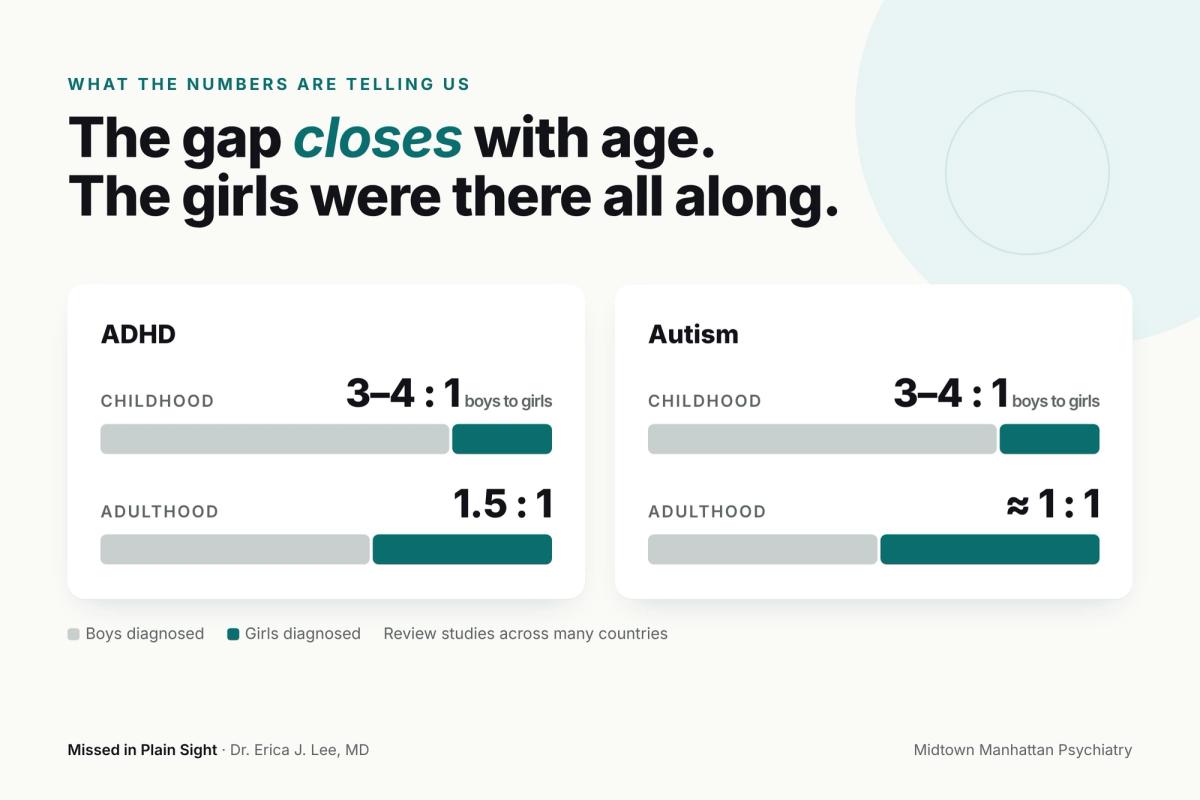
In childhood, boys are diagnosed with ADHD and autism 3 to 4 times as often as girls. By adulthood, the gap nearly closes.Chart: boys are diagnosed with ADHD and autism 3 to 4 times as often as girls in childhood, but the gap narrows to 1.5 to 1 for ADHD and nearly even for autism in adults
Some people read this as proof that these conditions are simply more common in young boys, and that girls develop them later. From my clinical experience, I read it differently. I think we are missing girls, women and people who are not boys, because the symptoms present differently.
In clinic, ADHD incidence in girls peaks at 17 or 18. That makes sense to me, because it peaks around transitions. My mentors in child psychiatry used to say that boys come in at the start of kindergarten or middle school, interrupting, acting out, unable to sit still. Girls, with more internalizing symptoms, come in later or never.
In my own practice, I see many girls and young women right before college or right after it, with symptoms they have had their whole lives and that nobody ever recognized.
Neurodivergent girls and women are missed until there are academic or social consequences. By then, it has been years, sometimes decades, and they are at risk of being blamed for their symptoms. That is the biggest risk of all.
How she actually walks in
Girls and women rarely come in saying “I think I have ADHD.” They come in emotionally dysregulated, overwhelmed, struggling with self-esteem and with friendships, feeling like they are not good enough. Young adults may be unable to hold a job or stay in college. Teenagers are getting Bs and Cs while everyone tells them, “You’re so smart, why aren’t you doing better?”
Most of the time, they come in for something else first:
- Intense anxiety about school, or school refusal because they feel nobody understands them
- Depression and self-hatred: “What is my purpose?”
- Physical symptoms, because sensory sensitivities are common in both ADHD and autism
- OCD, since both conditions make it easy to think in rigid loops
- Bipolar disorder and substance use, which we stereotype in impulsive boys but often see first in girls and women
- PTSD after traumatic events, which neurodivergent people are more likely to develop in full
- Borderline personality disorder
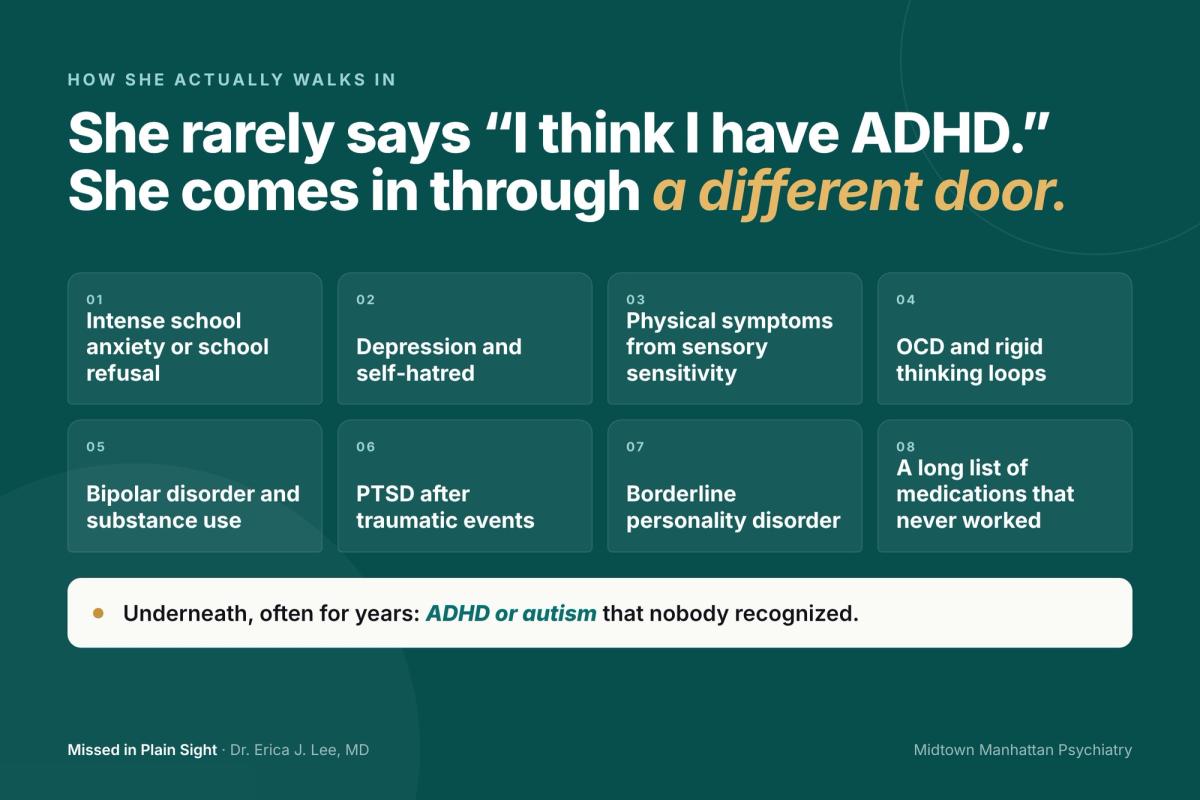
Girls often come in first for anxiety, depression, OCD or another condition, with ADHD or autism unrecognized underneath.Graphic: the eight conditions girls often come in with first, from school anxiety to a long list of medications that never worked, with ADHD or autism unrecognized underneath
A quick exercise I do with my patients
When I explain emotional regulation to parents and kids, I use a hand model of the brain. Hold up your hand. Your wrist is the brainstem, which keeps you breathing and alive. Fold your thumb into your palm: that is the limbic system, the seat of fight or flight and emotional memory. Now wrap your four fingers around your thumb. That is the prefrontal cortex, which helps you plan, decide and avoid risks.
In ADHD, the prefrontal cortex develops later and is thinner over time, so loosen your fingers a little. In autism, it develops atypically, so let your fingers sit unevenly along your thumb. Either way, the limbic system takes over more easily. That is what dysregulation looks like.
Fine in public, meltdowns at home
Girls and women are expected to be regulated, to have it together and to look okay in public. So many of them mask. They watch the peers they see as socially successful and mirror them. I have worked with girls who write and rehearse social scripts for asking someone out, giving a presentation or a college interview. Instead of running around, they think fast and talk fast.
Then they get home, to the one place where they feel safe, and they melt down or shut down. As my teenage patients say, they “crash out” at home.
What ADHD looks like in girls
I sometimes hear ADHD brushed off with “everyone has ADHD.” I take it seriously because untreated ADHD raises the risk of low self-esteem, emotional dysregulation, suicidal ideation, accidents, unplanned pregnancies, addiction, job instability and even premature mortality. It also explains many women I meet who come in on a long list of medications that never worked. People with ADHD and autism respond differently to medication and are often more sensitive to side effects.
As a reminder, the DSM-5 asks for 6 symptoms in a category for children, 5 from age 17, lasting at least 6 months in at least 2 settings, with symptoms present before age 12. Those symptoms may not cause problems until much later, especially in very bright people. I have heard many such stories from doctors and lawyers, my own colleagues included.
In girls, it usually looks like this:
- Inattentive first. She is daydreaming, “spacey”, disorganized, the girl who forgets her homework.
- Perfectionism. Bright girls use it to compensate. I see girls who spend three times as long on homework as their peers, for years, losing sleep, until the symptoms get worse.
- Hyperactivity on the inside. Racing thoughts and internal restlessness. Many tell me they simply cannot settle into bed.
- Hyperverbal. She is chatting in class and during homework, charismatic and good with people. The hyperactivity shows in how she talks, not in how she moves.
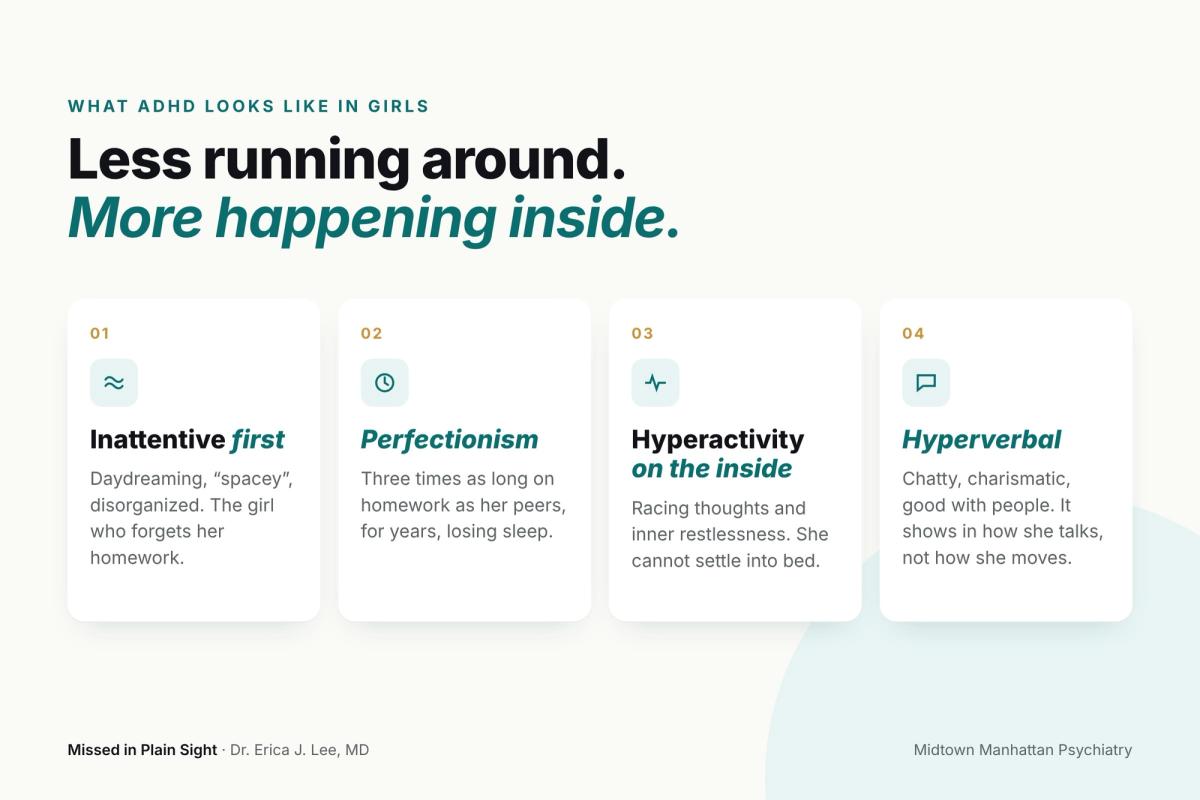
In girls, ADHD often shows up as inattention, perfectionism, inner restlessness and talking fast.Graphic: four ways ADHD shows up in girls: inattentive first, perfectionism, hyperactivity on the inside, and hyperverbal
Hormones and the menstrual cycle
This is one of my favorite parts of the conversation, because we are only beginning to study it. Estrogen enhances dopaminergic and noradrenergic signaling across the brain. When estrogen is low and progesterone dominates, ADHD symptoms get worse and stimulants work less well.
It is real. We see it in the late luteal phase, right before and at the start of a period. I also see perimenopausal and menopausal women come to my office with ADHD symptoms that have finally come to a head. Some people may need different stimulant doses at different points in their cycle, and there is a lot of work still to do here.
Autism in girls
Autism is a spectrum, and the DSM-5 asks for difficulties in social communication and interaction plus restricted, repetitive behaviors or interests. In girls, both categories are easy to miss.
Society expects girls to engage in back-and-forth conversation, so many of them learn to do it well. They mask in response to social feedback. Their special interests can just make them seem a little quirky. My patients have told me about anime, dogs and celebrities. Nobody batted an eye until they were a little too old for it, and it was all they wanted to talk about.
I also see more compulsions and rituals in girls, rather than the repetitive motor behaviors like flapping or echolalia that we associate with autism in boys and men.
When to refer, and where
Four kinds of patients make me think about ADHD or autism:
- She is underperforming at school, chronically dysregulated, or struggling with a traditional 9 to 5 schedule.
- She struggles to fit in and find friends. “I have one or two friends. What do we talk about? Only dogs.”
- She has racing thoughts and sleeps only a few hours a night.
- She has depression or anxiety that resists treatment, or a more stigmatized diagnosis like borderline personality disorder, and she was bright enough that nobody looked further.
For ADHD, child psychiatrists and many general psychiatrists are well trained to diagnose first line. Neuropsychological testing helps when the picture is unclear, or when there are speech or language delays to assess. The data for medication first is strong, for stimulants and for non-stimulants. CBT, executive functioning coaching, tutoring, occupational therapy and school accommodations all help too, because structure helps.
For autism, I like neuropsychological testing first, especially under 18, when it is easier to access. Wait lists can be long, so a developmental pediatrician or a psychiatrist can help in the meantime. We can make the clinical diagnosis, but the state and schools often want neuropsychological data, specifically ADOS testing, for services. For treatment, psychiatry and psychotherapy work best side by side.
What I told the room in the Q&A
Is it ever too early to refer? I may be biased, but I don’t think so. Whether someone has ADHD or autism, and whether to prescribe, are two different questions. Sometimes it simply helps to put a name on what is going on. I do watch and wait before diagnosing children under 4, because some of these behaviors are normal at that age.
What about girls who self-diagnose from Instagram or TikTok? I never start from a defensive stance. With some teens, we watch the reels together and talk them through. Those videos often capture lived experience that research has not caught up with. Usually, she is an anxious girl looking for an answer, and that conversation becomes an empowering one about how she wants to define herself.
What if she can’t tolerate stimulants? Stimulants are great for the people they work for, and they are not risk free. Non-stimulants have a clear role. Alpha agonists, for example, can help with sleep and with the racing, hyperverbal thoughts.
The bottom line
Girls and women with ADHD and autism are coming to us. They are just walking in through a different door: anxiety, depression, burnout, a long list of medications that never worked. When we learn to recognize the girl behind those symptoms, we can stop blaming her for them and start helping her.
▶ Watch the full replay of Missed in Plain Sight on YouTube, including the Q&A.
✦ ✦ ✦
About the Physician
Dr. Erica J. Lee, MD, is a child, adolescent and adult psychiatrist and the founder of Midtown Manhattan Psychiatry. She earned her medical degree at Brown, trained at Harvard and completed her child and adolescent psychiatry fellowship at Montefiore.
This article is adapted from her October 14, 2026 webinar for Mind Care Loop and Well Women, Doctoloop’s private communities for clinicians in New York. It is for educational purposes only and is not medical advice.